


 | Published: June 24, 2026 | Updated: June 24, 2026
After 80 years of magnetron dominance, a fundamentally different approach to radar has taken over — and the reasons why tell a compelling story about how far the technology has come.
For decades, marine radar relied on magnetron technology, a vacuum tube-based transmitter first developed during World War II. It worked, and it worked well enough that the industry stuck with it for generations. But solid state radar has steadily displaced the magnetron as the technology of choice for modern marine installations – let’s unpack this in this article.
How solid state radar works
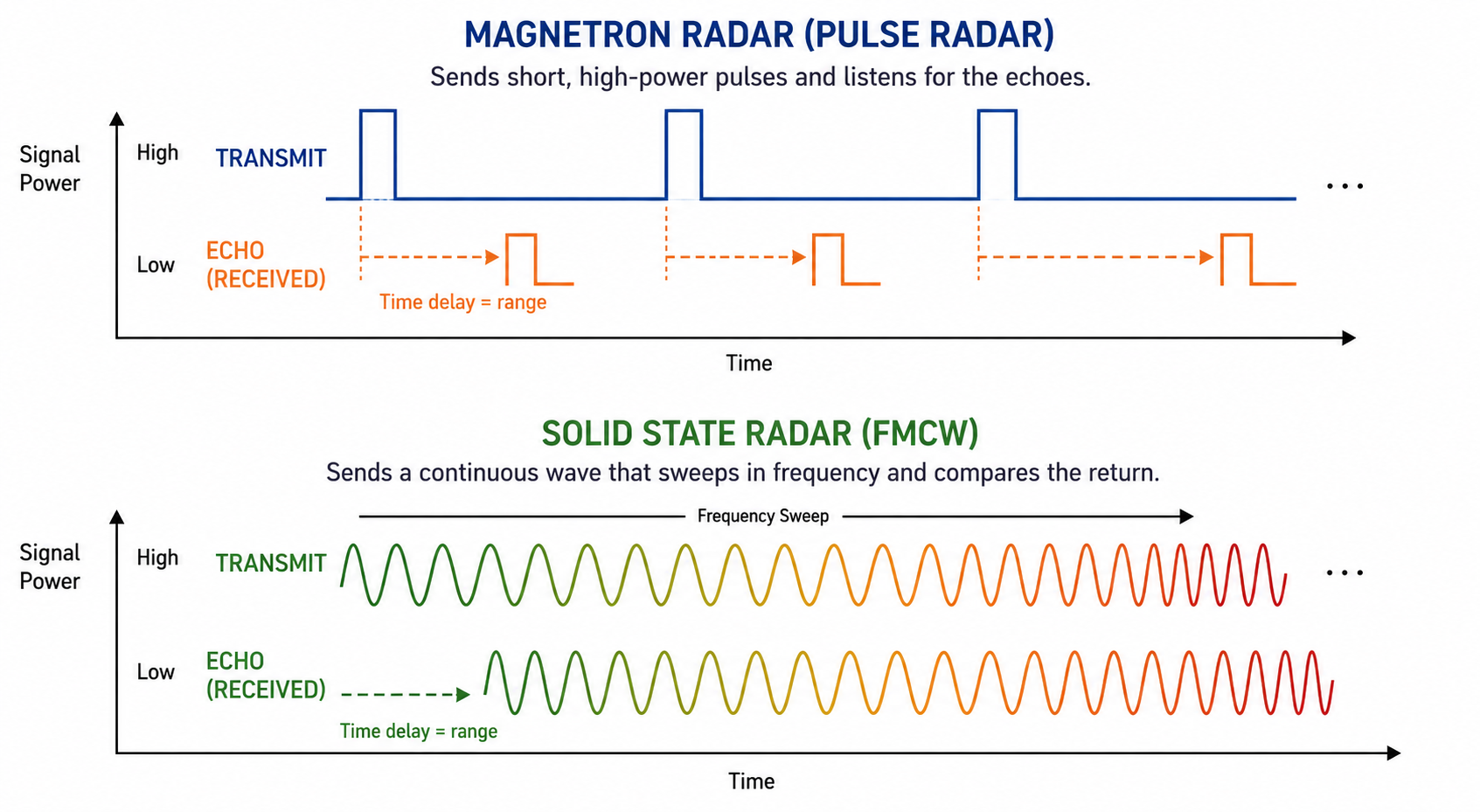
Traditional magnetron radar fires short bursts of microwave energy at very high peak power, typically several kilowatts, and measures how long each pulse takes to return. It worked well enough that the industry stuck with it for generations.
Solid state takes a fundamentally different approach. Rather than high-power pulses, it transmits a continuous frequency-modulated signal at much lower power, then uses sophisticated digital signal processing to extract target information. The most common implementation is FMCW (Frequency Modulated Continuous Wave). The radar sweeps through a range of frequencies in a known pattern, and by comparing what was sent to what comes back, it can calculate range with precision. It trades raw transmit power for processing intelligence.
Where solid state genuinely excels
Four practical advantages stand out:
- Instant startup – Ready to scan in seconds. Magnetron units need 2-3 minutes to warm up, which matters in fast-moving situations.
- No wear-out – No high-voltage components to degrade. Magnetrons gradually lose output power and eventually need replacing – a costly offshore service job. A solid state transmitter can realistically last the life of the vessel.
- Close-range detection – FMCW systems can detect targets just metres away. Magnetron systems have a minimum blind zone directly around the vessel due to pulse length constraints – a real issue in ports, rivers, and marinas.
- Sharper target separation – Low-noise transmitters combined with high-resolution DSP let solid state radars resolve closely-spaced targets more effectively, and build a usable picture at lower gain settings.
The trade-offs worth knowing
No technology is without compromise. At equivalent antenna sizes, solid state units generally produce lower peak power than magnetron equivalents, which can affect performance in extreme precipitation or at very long range. High-end systems compensate through processing and antenna design, but at the very top of the range scale, the comparison occasionally still favours the magnetron.
Cost at the entry level remains a consideration, though the gap has narrowed significantly as volumes have grown and the technology has matured.

The bottom line
Solid state radar is a genuine generational shift. For most vessels, particularly those where reliability, close-quarters safety, and low ownership cost matter, the case is compelling. Faster startup, no tube replacements, superior short-range performance, and reduced maintenance requirements all point in the same direction. Long-range performance in extreme conditions remains the one area where the magnetron can still argue its corner.
Actisense and Raymarine: NMEA Intelligence Behind the Pathfinder
Solid state radar doesn’t operate in isolation. Getting the most from modern radar systems depends on the quality of data flowing through the vessel’s wider navigation network — and that’s where NMEA infrastructure becomes critical.
Actisense worked with Raymarine on their Pathfinder system, providing a custom PRO-MUX intelligent multiplexer as the core of its Data Collection Unit. The Pathfinder is designed for the commercial marine and SOLAS environment — an IMO-compliant system built to simplify operation without compromising capability.
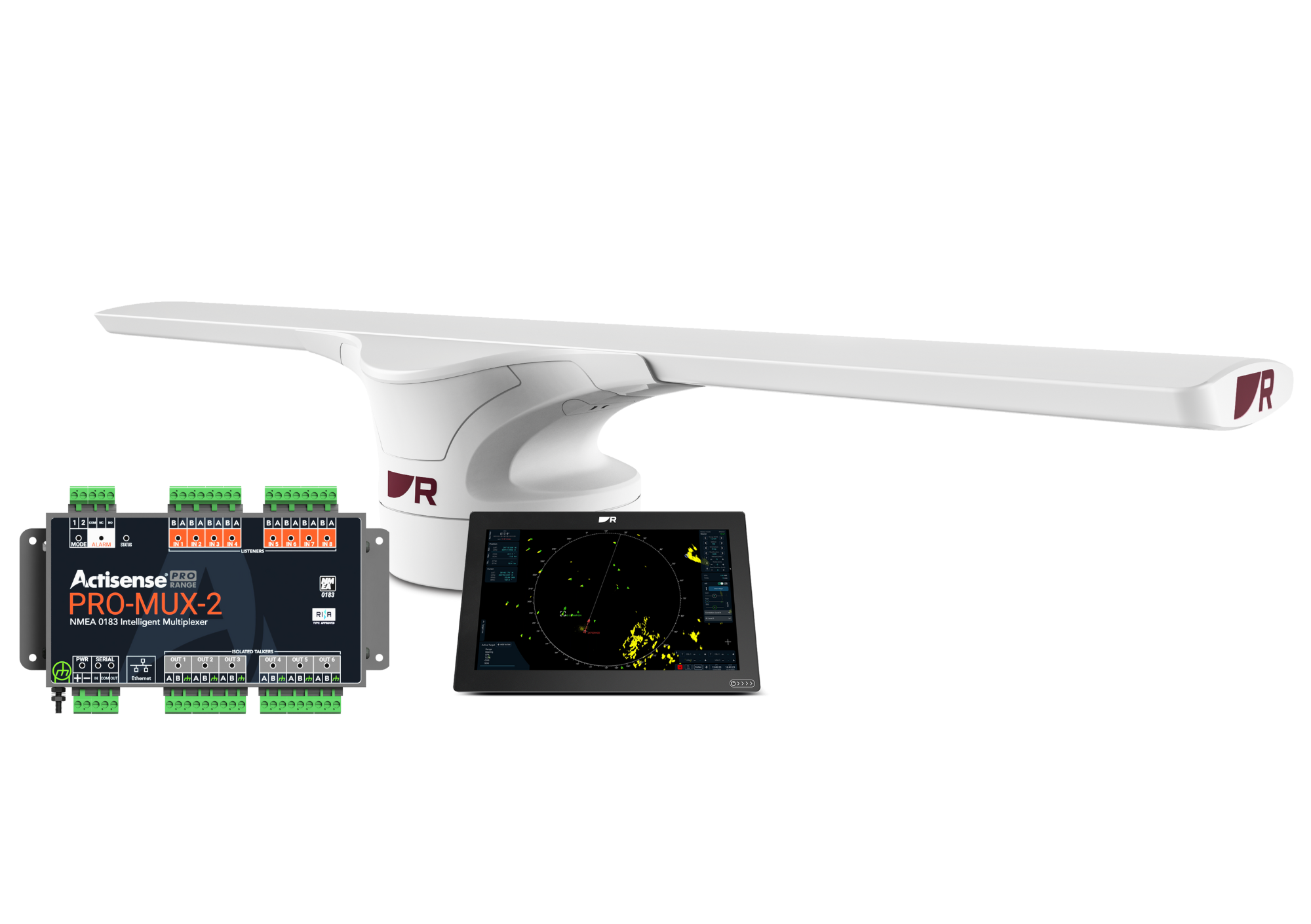
Raymarine’s Director of Navigational Solutions, Andy Murray, noted that the Actisense solution ensures an extremely flexible interfacing capability at the heart of Pathfinder, making the system straightforward to install on both retrofits and new builds.
It’s a practical example of how radar technology and NMEA data handling work together — and why both matter when specifying a modern marine electronics fit-out.
 What is Radar?
  3 Common Dangers at Sea and How to Avoid them