


 | Published: October 14, 2026 | Updated: October 14, 2026
Radar is one of the most data-hungry instruments on a vessel. However, when it talks to the rest of the ship over NMEA 0183, it sends only a small part of what it knows. The radar picture itself never travels over NMEA 0183. What does travel is the radar’s processed output: tracked targets, status and control information.
That output is valuable, and a lot of equipment wants it at the same time. A chart plotter, an AIS overlay, a VDR and a bridge alarm system may all be listening. In this article, we’ll look at how the data leaves the radar, why a single serial output can’t always serve every device, and how an NMEA 0183 buffer solves the problem.
What your radar actually sends over NMEA 0183
Inside the radar
The radar processes the echo returns internally. Its ARPA (or equivalent target-tracking) function detects echoes, associates them across successive sweeps, and builds a track for each target with a position, course, speed and closest point of approach. Only these track-level results are formatted as NMEA 0183 sentences. The raw video stays on the radar’s own proprietary link, typically Ethernet or analogue.
To track targets properly, the radar also needs inputs of its own: heading, speed and sometimes position, usually from a compass, log or GPS. These arrive over NMEA 0183 or another interface, so the radar is both a listener and a talker.
The sentences that carry the data
Radar output is sent as standard ASCII sentences. The talker ID for radar is RA, so a tracked-target message begins $RATTM. Some of the main sentences are:
- TTM (Tracked Target Message): target number, distance, bearing, speed, course, CPA, TCPA, target name, status and time.
- TLL (Target Latitude and Longitude): target position as lat/lon instead of relative bearing and range.
- TLB (Target Label): the names or labels attached to target numbers.
- RSD (Radar System Data): range scale, cursor/EBL/VRM information and display settings.
The electrical layer
NMEA 0183 is a single-talker serial standard. The radar’s output is a differential pair (commonly labelled A and B, or TX+ and TX−) at 4800 baud, with 8 data bits, no parity and 1 stop bit. Some devices support the 38400 baud high-speed rate, which is used for AIS and increasingly for busy radar output.
The talker is designed to drive a small number of listeners, traditionally up to three, each of which takes a small current through an opto-isolated input. That limit is where the trouble starts.
The problem: one talker, many listeners
A radar has one NMEA 0183 output, and a modern bridge or boat may want that data in several places:
- A chart plotter or ECDIS for target overlay
- A dedicated collision-avoidance or alarm system
- A voyage data recorder or logging PC
- A repeater display or secondary station
The obvious fix is to wire them all in parallel on the radar’s output, but that has real drawbacks:
- Loading: every listener draws current, and the talker can only drive so many before the signal degrades.
- Fault propagation: a short, miswire or failed input on one listener can corrupt the signal for all the others.
- Ground loops and noise: connecting several devices on different supplies and grounds can inject noise or create ground loops.
- Wiring complexity: long parallel runs with multiple joins are hard to build and hard to fault-find.
How an NMEA 0183 buffer solves the problem
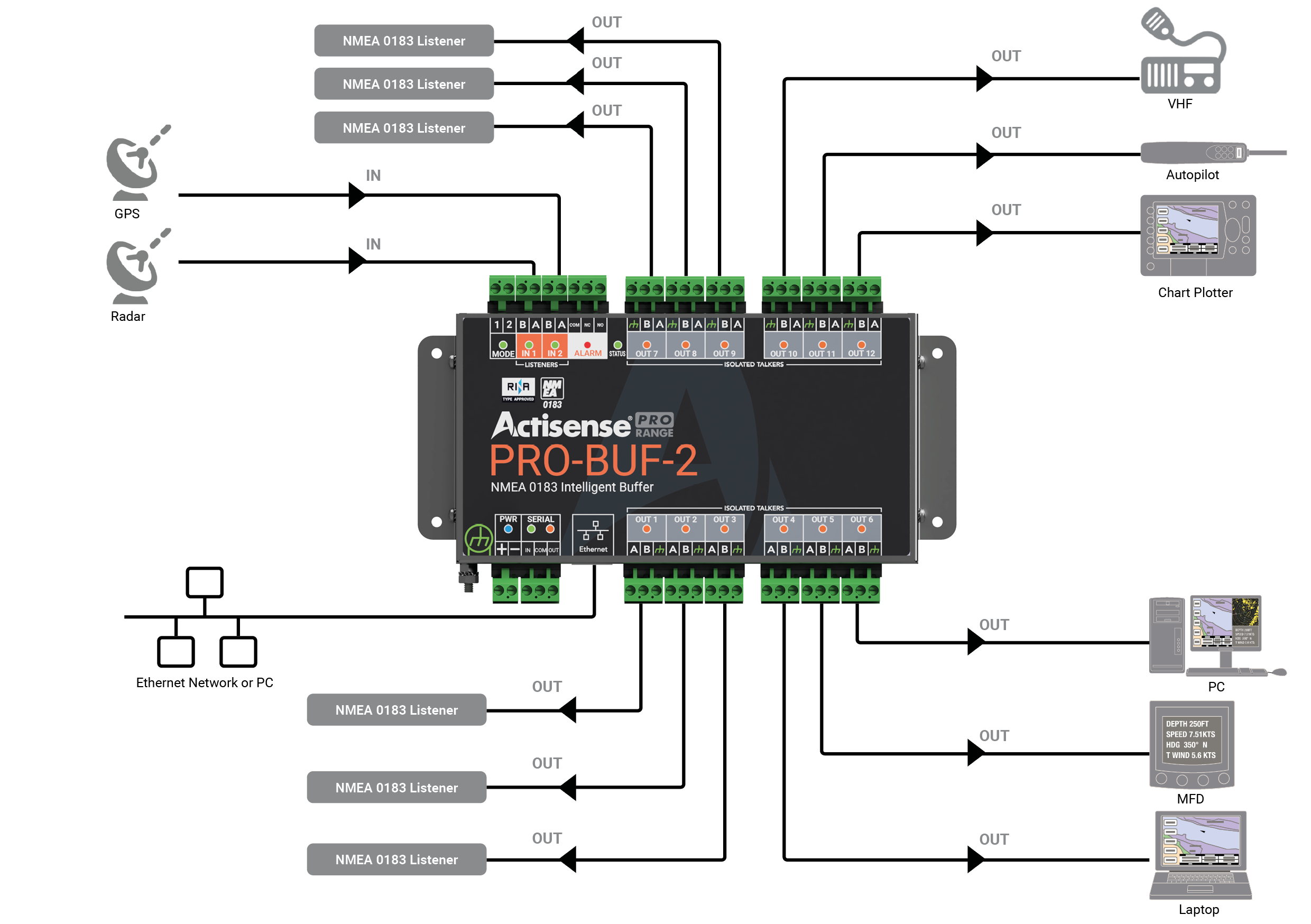
An Actisense buffer accepts the radar’s output on an isolated input and regenerates the signal onto several independent isolated outputs. Each output is driven by the buffer’s own output drivers, so the original talker only ever sees one load. This brings several benefits:
- Fan-out: one radar input to the buffer becomes multiple identical outputs, one for each listener or group of listeners. The buffer has a controlled output drive, meaning each output is individually driven and can connect to multiple listeners.
- Isolation: the input is optically isolated, which breaks ground loops and protects the radar from faults downstream. The outputs on Actisense buffers are also isolated using ISO-Drive technology.
- Fault containment: a short or fault on one output should not take down the others, which is exactly what you want when a failure on one device shouldn’t blind the rest of the system.
- Signal regeneration: each output is a clean, correctly driven signal, which helps over longer cable runs.
Simple or intelligent: choosing your Actisense buffer
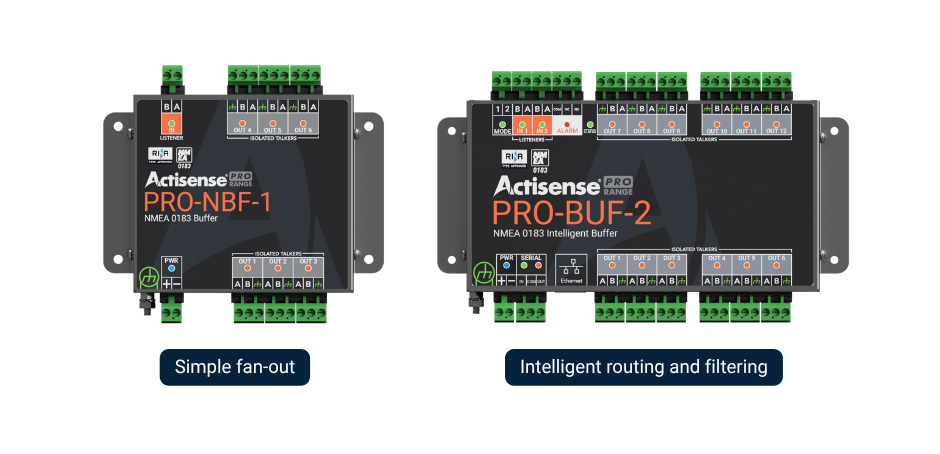
The Actisense buffers offer both a simple and a more intelligent option. The PRO-NBF-1 is a non-intelligent buffer that simply takes the input signal and drives it to multiple outputs. The PRO-BUF-2 is an intelligent buffer solution that allows for baud rate adjustment, filtering, advanced routing and much greater monitoring of data.
Both work well. The right choice depends on what you need the buffer to do.
Installing a buffer: step by step
- Connect the radar’s NMEA 0183 output to the buffer’s input, matching A to A and B to B (or TX+ and TX− to the corresponding input terminals). Check polarity in both the radar and buffer manuals, because manufacturers label terminals differently.
- Wire each listener to its own buffer output. Keep each device on its own output so one problem can’t spread.
- Match the baud rate across the radar, buffer and every listener. A buffer repeats the signal and does not convert rates unless configured to do so. Check your specific model’s documentation.
- Power the buffer from a clean, correctly fused supply, ideally the same bus as the equipment it serves.
- Verify with a monitor. Use a serial monitor or NMEA Reader on each output and confirm the sentences are valid with checksums passing.
Will 4800 baud keep up? Bandwidth and update rates
At 4800 baud, you can send roughly 480 characters per second. A typical TTM sentence is around 70 to 80 characters, so the link carries about six TTM sentences per second at best, shared with every other sentence the radar sends.
With many tracked targets and a fast update rate, a 4800 baud link can saturate. You’ll see this as delayed or dropped target updates. If the radar and every listener support 38400 baud, using it gives roughly eight times the headroom. The buffer itself adds no meaningful latency, so the bottleneck is the baud rate set at the radar.
Troubleshooting common problems
- No data on any output: check the input polarity and the radar’s output configuration. Confirm the radar is set to transmit target sentences, since TTM output is often disabled by default.
- Garbled data: this is almost always a baud rate or parity mismatch.
- One listener works, another doesn’t: test the failed output separately, check A/B polarity at that device, and confirm it expects the same sentences and baud rate. Some listeners ignore TTM entirely.
- Intermittent corruption: look at cable quality, shield grounding and routing near high-current cables or radar power runs.
- Missing targets on one display: the display may be filtering sentence types, or the radar’s update rate may exceed what the baud rate supports.
Key takeaways
The radar converts its tracked-target data into standard NMEA 0183 sentences, principally TTM, TLL, TLB and RSD, and sends them as a single differential serial output. A buffer takes that one output, isolates it and regenerates it to multiple independent outputs, so each listener gets a clean copy without loading the radar or risking cross-contamination.
To get it right: match baud rates, keep one listener per output, and watch the bandwidth budget as the target count grows.
 Which NMEA 0183 multiplexer/buffer do I need?