


 | Published: January 21, 2026 | Updated: January 22, 2026
It’s the start of a new year, the weather isn’t exactly inviting, and your boat is probably out of the water. Perhaps you’ve added a few new electronics over the holidays, or you’re simply using the quieter months to plan ahead. Either way, this can be a great time to take a fresh look at your NMEA 2000 network.
If I were building an NMEA 2000 network from scratch today, here’s exactly how I’d approach it, and, just as importantly, what I’d avoid. This is a back‑to‑basics guide, focused on getting the fundamentals right so you don’t have to troubleshoot problems later.
First, I’d make sure I understand what NMEA 2000 actually is
Before starting, I’d remind myself what NMEA 2000 really is and why it’s been so widely adopted.
NMEA 2000 is an open standard created by the National Marine Electronics Association (NMEA). Its purpose is to standardise both the messages and the connector system used by marine electronics, so devices from different manufacturers can communicate reliably on the same network.
One thing I wouldn’t do is assume that “open standard” means “free”. The NMEA standards are available to purchase directly from the NMEA, and that income helps support the organisation, which operates on a not-for-profit basis.
If I wanted complete peace of mind, I’d only use NMEA 2000-certified devices. Certification exists for a reason: it reduces risk, improves compatibility, and removes a lot of guesswork.
I’d start with the absolute minimum requirements
Every NMEA 2000 network, no matter how small, has some non-negotiables. From the start, I’d ensure these are in place:
- A fused power insertion point (for example, an Actisense A2K-MPT-2 connected to a fused battery supply)
- 2 NMEA 2000-certified devices, plus cables and connectors to build the network
- 2 termination resistors
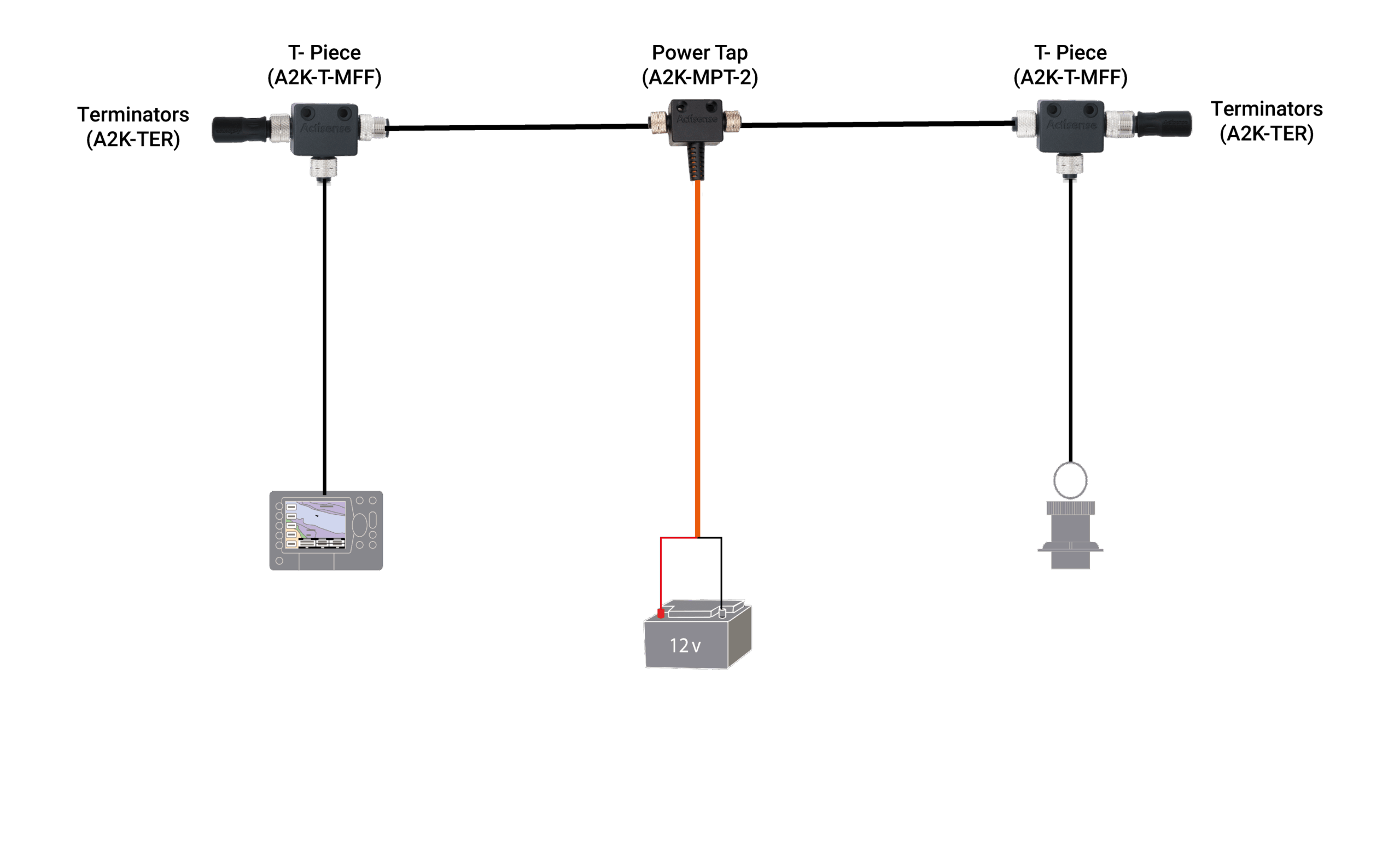 Having these fundamentals in place from the start helps everything else fall into place more easily.
Power: I’d keep it simple and safe
Power insertion on an NMEA 2000 network is relatively straightforward, and I’d keep it that way.
On a smaller network, I’d normally use a single power insertion point fed from the boat’s dedicated power supply, breaker, or battery. The key rules I’d stick to are:
- NMEA 2000 operates at 9-16 VDC – never connect a 24 V battery directly to the network
- I’d always use a fuse – they’re cheap, quick to install, and they protect both the network and the connected equipment
I also wouldn’t guess the fuse rating. A 1A fuse is too low for most micro-cable networks (which support up to 3A), but a 20A fuse is far too high and won’t blow even if the network is pulling far too much power. Your equipment would be damaged before the fuse blew.
I’d respect the physical layer
The cabling, connectors, and T-pieces form what’s known as the NMEA 2000 physical layer. This part of the standard is based on DeviceNet, a proven and robust networking system already used in industries like automotive and agriculture.
This is an area where keeping things conventional tends to pay off.
DeviceNet defines:
- Cable sizes
- Wire colours
- Connector pinouts
Because of this, NMEA 2000 networks benefit from true plug-and-play installation. Screw-type connectors make it quick to assemble, and the wiring to each pin is clearly defined in the NMEA 2000 specification, making installation standard across NMEA 2000 installations.
If I wanted a reliable network, I’d stick to compliant cables and connectors, no shortcuts.

Backbone and termination: I’d get this right first time
The backbone is the central structure of any NMEA 2000 network, and I’d design it carefully before installing anything.
Here’s what I’d do:
- Build a single backbone using an appropriate backbone cable
- Connect every device via a T-piece (this is known as an instrument drop)
- Add one termination resistor at each end of the backbone
Those two 120 Ohm termination resistors are critical. Connected in parallel, they provide a total network termination of 60 Ohms. Without correct termination, communication issues are almost guaranteed.
Final thought: Build it right, then build it bigger
If I were starting from scratch, I’d focus less on how many devices I want today and more on building a solid, standards-compliant foundation.
Getting the power right, using the physical layer as intended, and taking care with backbone design and termination all help to set the network up for long-term reliability. Once those basics are in place, expanding or adapting the network later tends to feel much easier.
Take the time at the beginning and your NMEA 2000 network should run smoothly.

 3 common mistakes when installing NMEA devices
  The basics of building and testing your NMEA 2000 Network
  3 fundamentals of designing a fault free NMEA 2000 network