


 | Published: September 30, 2026 | Updated: October 1, 2026
A fire on a vessel is a different problem from a fire ashore. There is no fire brigade a few minutes away, the spaces are enclosed and cramped, and evacuation routes are narrow and often dimly lit. In that setting, what a burning cable gives off can matter as much as whether it burns at all. That is the case for Low Smoke Zero Halogen (LSZH, LS0H) cable.
What is LSZH?
LSZH refers to the jacket and insulation compounds, not the conductive materials in the wiring. Instead of the standard PVC, which contains chlorine, LSZH cables use halogen-free thermoplastic or thermoset compounds, typically with mineral fillers.
These compounds are engineered to do three things when exposed to fire:
- Produce little smoke, so visibility is preserved
- Emit no significant, harmful halogen gases (chlorine, fluorine, bromine)
- Resist flame propagation along the cable run
Why standard PVC jacket cable is a concern in a fire
PVC is inexpensive, flexible, durable and easy to process, which is why it is everywhere. Its weakness is what it does when it burns. The chlorine in PVC is released as hydrogen chloride gas, which combines with moisture (in the air, or in the lungs and eyes) to form hydrochloric acid. Burning PVC also produces dense, dark smoke.
That creates three hazards on a vessel:
- Toxicity and irritation – acid gases impair breathing and sting the eyes, making it harder for crew and passengers to escape.
- Visibility – thick smoke slows evacuation and firefighting, particularly in corridors, machinery spaces and accommodation decks.
- Corrosion – acid gases attack electronics, switchboards and metalwork, sometimes long after the fire is out. On a ship, that can mean equipment damage well beyond the fire’s footprint, affecting navigation, communications and control systems, and adding significant repair costs.
LSZH vs standard jackets
| Standard PVC | LSZH | |
|---|---|---|
| Halogen gas emission in fire | High (HCl) | Very low / non significant |
| Smoke density | Dense, dark | Low, light-permeable |
| Corrosive by-products | Yes | Minimal |
| Flame retardance | Achievable with additives | Achievable, often built in |
| Flexibility | Generally excellent | Often slightly stiffer |
| Abrasion, oil and chemical resistance | Good | Varies by compound; marine grade cable like the A2K Mid Bulk Cable is UL13 |
| Cost | Lower | Slightly higher |
LSZH doesn’t make a cable fireproof, and it doesn’t make a fire harmless. Burning cable still produces some smoke and carbon monoxide. What it does is remove the worst of the secondary hazards and buy people time.
The standards behind the claims
“LSZH” is a description, not a certification, so it’s worth knowing which tests a cable is actually claimed to meet. The common ones are:
- IEC 60332-3 (Category A/B/C): flame propagation of bunched cables
- IEC 60754-1 / -2: halogen content and acidity/conductivity of gases evolved on combustion
- IEC 61034: smoke density, measured as light transmittance
- IEC 60092-350 / -353 / -376 and IEC 60092-360: shipboard cable construction and insulating/sheathing materials
- IEC 60331: fire-resistant cables that maintain circuit integrity (a separate property, often needed alongside LSZH for essential services)
Note that LSZH and fire-resistant are different things. A cable can be LSZH without maintaining circuit integrity in a fire, so critical circuits usually need both.
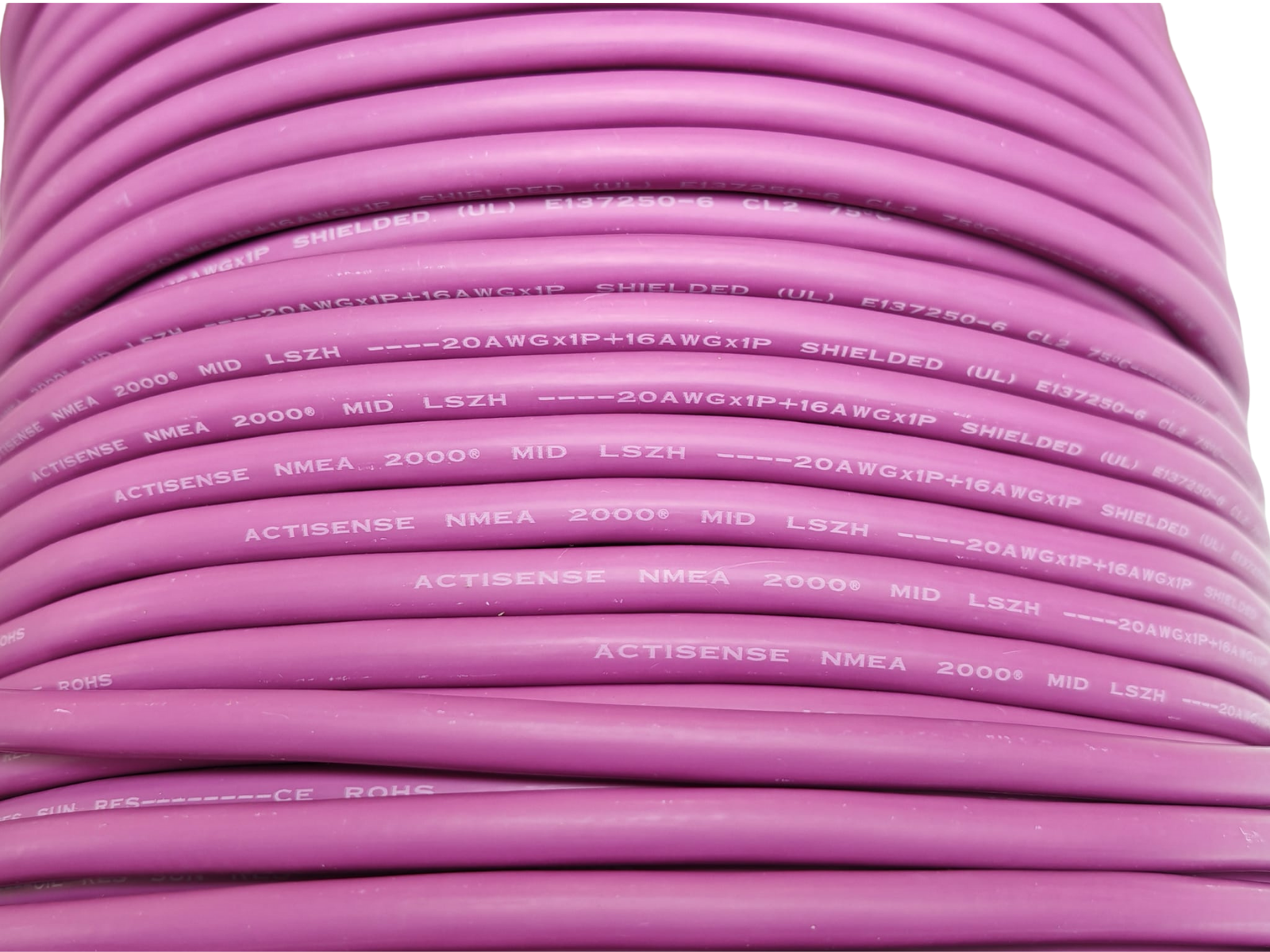
The Actisense Mid Bulk cable (and SBN-3 when released) are certified to IEC60754-1/2 and IEC 61034.
So where is LSZH required?
Requirements come from a combination of international regulation, class society rules, flag state requirements and owner or yard specifications, so the honest answer is “it depends on vessel type.”
- SOLAS requires shipboard cables to be at least flame retardant and installed so they don’t lose those properties. It doesn’t blanket-mandate halogen-free cable for every ship.
- Class societies (such as DNV, Lloyd’s Register, ABS, Bureau Veritas) set detailed rules for cable types by vessel category and space, and many call for low-smoke, halogen-free cable in specific areas or ship types.
- Passenger ships and cruise vessels are where LSZH is most consistently expected, given the number of people who must be evacuated.
- Naval and government vessels commonly specify low-smoke, low-toxicity cable through defence standards, such as UK Def Stan or US military specifications.
- High-speed craft, large yachts and offshore units frequently specify LSZH through their applicable codes, class rules or owner requirements.
If you’re specifying cable for a particular vessel, check the current class rules and the build specification directly. They vary by ship type, tonnage and space, and they change.
Main use cases
- Accommodation and public spaces: cabins, corridors, restaurants, theatres and control rooms, where people are present, and evacuation is the priority
- Passenger and cruise vessels: throughout, for power, lighting, data and communications
- Machinery spaces and engine control rooms: with oil-resistant SHF2 MUD grades where required
- Navigation bridge and communications: protecting sensitive electronics from corrosive gases
- Data and networking: Ethernet, fibre and instrumentation cabling in enclosed spaces, including NMEA-based and CAN-based bus systems where the installation environment calls for it
- Military and patrol vessels: where crew survivability and equipment continuity are design drivers
- Superyachts: high-value interiors with owner and guest safety expectations, often built to large yacht codes
- Offshore installations and platforms: enclosed, hard-to-evacuate environments with strict fire and gas performance requirements
- Mixing cables. Where a run passes between spaces with different requirements, specify to the more demanding one rather than splicing between types.
In summary
LSZH cable doesn’t stop fires, but it changes what a fire does to the people and equipment on board: clearer air, better visibility, less corrosive damage and more time to act. Where regulation or class rules require it, it’s non-negotiable. Where they don’t, it’s often still the sensible choice for enclosed spaces where people live, work and have to evacuate.
 3 Common Dangers at Sea and How to Avoid them
  Can digitizing electronics really improve safety at sea?