


 | Published: May 13, 2026 | Updated: May 19, 2026
A guide to modern marine network integration
TL;DR
Modern vessels run two main data protocols: NMEA 0183 (serial, legacy) and NMEA 2000 (CAN bus, modern). Neither was designed for Ethernet, but both can be bridged to it, letting a single instrument feed chartplotters, navigation software, and logging systems across the whole vessel network simultaneously.
Key takeaways:
- NMEA 0183 travels over Ethernet via TCP or UDP, typically on port 10110. Use TCP for single clients, UDP for broadcasting to multiple devices.
- NMEA 2000 requires a dedicated gateway device to translate CAN bus data to IP — it cannot be connected directly.
- Put instruments on a dedicated subnet or VLAN, use static IPs or DHCP reservations, and never expose NMEA servers directly to the internet.
- Wired Ethernet for helm and autopilot; Wi-Fi is fine for secondary displays and monitoring.
- In mixed-manufacturer setups, a standalone N2K gateway (such as the Actisense W2K-2 for wireless, or PRO-NDC-1E2K for wired) is more reliable than depending on an MFD to share bus data.
Introduction
Modern vessels are floating sensor networks. GPS receivers, depth sounders, wind instruments, AIS transponders, autopilots, and engine monitors all generate continuous streams of navigational data. The challenge lies in getting that data to every device that needs it (chartplotters, navigation software, voyage data recorders, and remote monitoring systems) without running separate cables to each one.
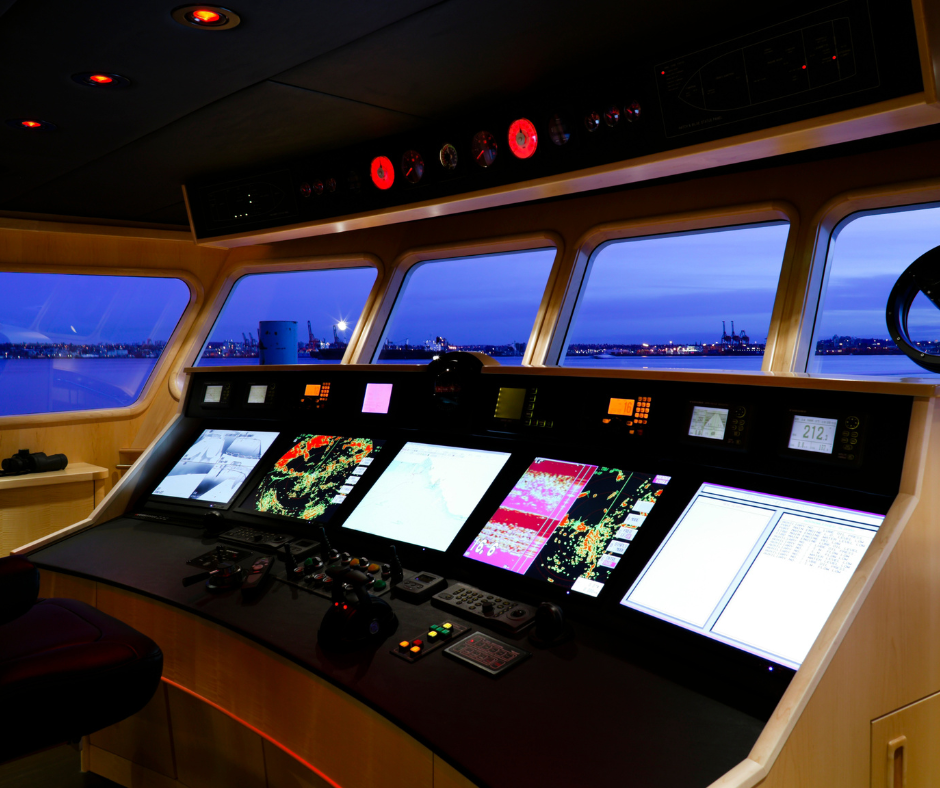
Two standards dominate marine electronics: NMEA 0183, a simple serial protocol that has been the industry standard since the 1980s, and NMEA 2000 (N2K), the modern CAN bus-based network that offers higher speed, richer data, and true plug-and-play device discovery. Neither was designed with Ethernet in mind, but both can be bridged to it effectively using the right hardware.
This article covers the key concepts, hardware options, and network design considerations for sharing NMEA data over a vessel’s Ethernet LAN.
The protocols
NMEA 0183
NMEA 0183 uses RS-422 differential signalling (occasionally RS-232 on older devices). Sentences are transmitted as ASCII text at typically 4800 baud, or 38400 baud for high-speed sources like AIS receivers.
A typical GPS position sentence looks like this:
$GPGGA,092750.000,5321.6802,N,00630.3372,W,1,8,1.03,61.7,M,55.2,M,,*76
The most significant limitation of NMEA 0183 is its one-talker topology: a GPS or depth sounder can only drive one listener on a single RS-422 pair. Sharing that signal with multiple devices requires either a hardware multiplexer or a serial-to-Ethernet converter, which is the foundation of most Ethernet integration approaches.
NMEA 2000
NMEA 2000 is built on the CAN (Controller Area Network) bus, running at 250 kbps over a linear backbone with drop cables and 120Ω terminators at each end. Data is transmitted in binary Parameter Group Numbers (PGNs), each defining a specific type of information:
| PGN | Name | Description |
| 127250 | Vessel Heading | Magnetic/true heading, deviation |
| 128259 | Speed Through Water | Boat speed, water reference |
| 129025 | Position, Rapid Update | Lat/lon at up to 10 Hz |
| 129029 | GNSS Position Data | Full GPS fix with DOP and mode |
| 130306 | Wind Data | Speed and angle, apparent/true |
| 127488 | Engine Parameters, Rapid | RPM and boost pressure |
| 129038 | AIS Class A Position Report | AIS target position |
Unlike NMEA 0183, N2K is inherently a multi-talker, multi-listener bus, meaning any device on the backbone can read any PGN. Bridging to Ethernet means translating from a CAN bus to a routable IP network, which requires a dedicated gateway device.
Why Ethernet?
A few common scenarios make Ethernet integration worthwhile:
- Multi-station access: A single GPS or AIS unit can feed the helm chartplotter, a navigation PC below decks, and a tablet in the cockpit simultaneously, without additional wiring.
- Software integration: Navigation applications such as OpenCPN, Expedition, and Coastal Explorer consume NMEA data via TCP or UDP sockets. Ethernet makes this straightforward.
- Data logging: A computer on the vessel’s LAN can record all instrument data for post-voyage analysis or insurance records.
- Remote monitoring: Via a cellular router or satellite modem, NMEA data can be forwarded to shore for fleet tracking or engine health monitoring.
- Cross-network bridging: Many vessels carry a mix of N2K instruments and legacy NMEA 0183 devices. Ethernet provides a common fabric that connects both.
NMEA 0183 over Ethernet
TCP vs. UDP
Two transport protocols are used in practice, both commonly on port 10110 (a widely adopted convention, though not formally standardised):
TCP is connection-oriented and guarantees delivery. It is preferred when connecting to a single client, or when bidirectional communication is needed. For example, sending waypoints or commands to an autopilot.
UDP is connectionless and lower overhead. It is better suited to broadcast scenarios where multiple clients on the same LAN should all receive the NMEA stream. UDP also supports multicast, which is the most efficient approach for multi-client distribution.
NMEA 2000 over Ethernet
The Gateway Requirement
NMEA 2000 CAN bus data cannot be directly placed on an IP network—the physical and logical layers are entirely incompatible. A gateway device bridges the two. It participates on the N2K bus as a legitimate device (with a claimed bus address) and simultaneously presents data to the Ethernet LAN.
Gateways operate in two general modes:
- Read-only (passive): Listens to all PGNs on the N2K bus and forwards them to the network. Sufficient for most monitoring and display use cases.
- Bidirectional: Allows software on the LAN to transmit PGNs back onto the N2K bus, enabling remote control of autopilots, plotters, or other N2K devices from a networked application.
Network Design
IP Addressing
A dedicated subnet for marine instruments avoids conflicts with crew devices and simplifies firewall rules. A typical small-vessel allocation:
192.168.2.0/24 — Marine instrument network
192.168.2.1 — Router / default gateway
192.168.2.10 — Navigation PC
192.168.2.20 — Chartplotter MFD (helm)
192.168.2.21 — Chartplotter MFD (nav station)
192.168.2.30 — Actisense W2K-2 (N2K Wi-Fi gateway)
192.168.2.40 — AIS transponder
Use static IP addresses or DHCP reservations by MAC address for all instrument devices. Dynamic address assignment can silently break software configurations after a power cycle.
VLAN Segmentation
On larger vessels with managed switches, VLANs keep instrument traffic isolated from crew Wi-Fi and entertainment systems:
- VLAN 10 — Marine instruments (restricted internet access)
- VLAN 20 — Crew Wi-Fi and personal devices
- VLAN 30 — Management network
This prevents crew devices from inadvertently connecting to instrument servers and provides a security boundary if the vessel has internet connectivity.
Security
As vessels become more connected, network security matters:
- No direct internet exposure of NMEA TCP servers. Use a VPN such as WireGuard for any remote access.
- Firewall rules: Block unsolicited inbound connections to the instrument network from WAN interfaces.
- Separate SSIDs: Never bridge the crew Wi-Fi directly to the instrument VLAN.
Bandwidth and Latency
NMEA data is low-bandwidth by modern standards; even a very busy NMEA 2000 network would not put any significant strain on a basic 100Mb/s Ethernet connection (which by today’s standards is low anyway).
Latency matters more than bandwidth. Autopilot control loops and high-rate position updates are sensitive to delivery delays. Use wired Ethernet for helm stations and autopilot interfaces. Wi-Fi is acceptable for secondary displays and monitoring clients where 10–50 ms latency is tolerable.
Commercial MFD Integration
Most major MFD manufacturers support NMEA 0183 over Ethernet alongside their proprietary protocols.
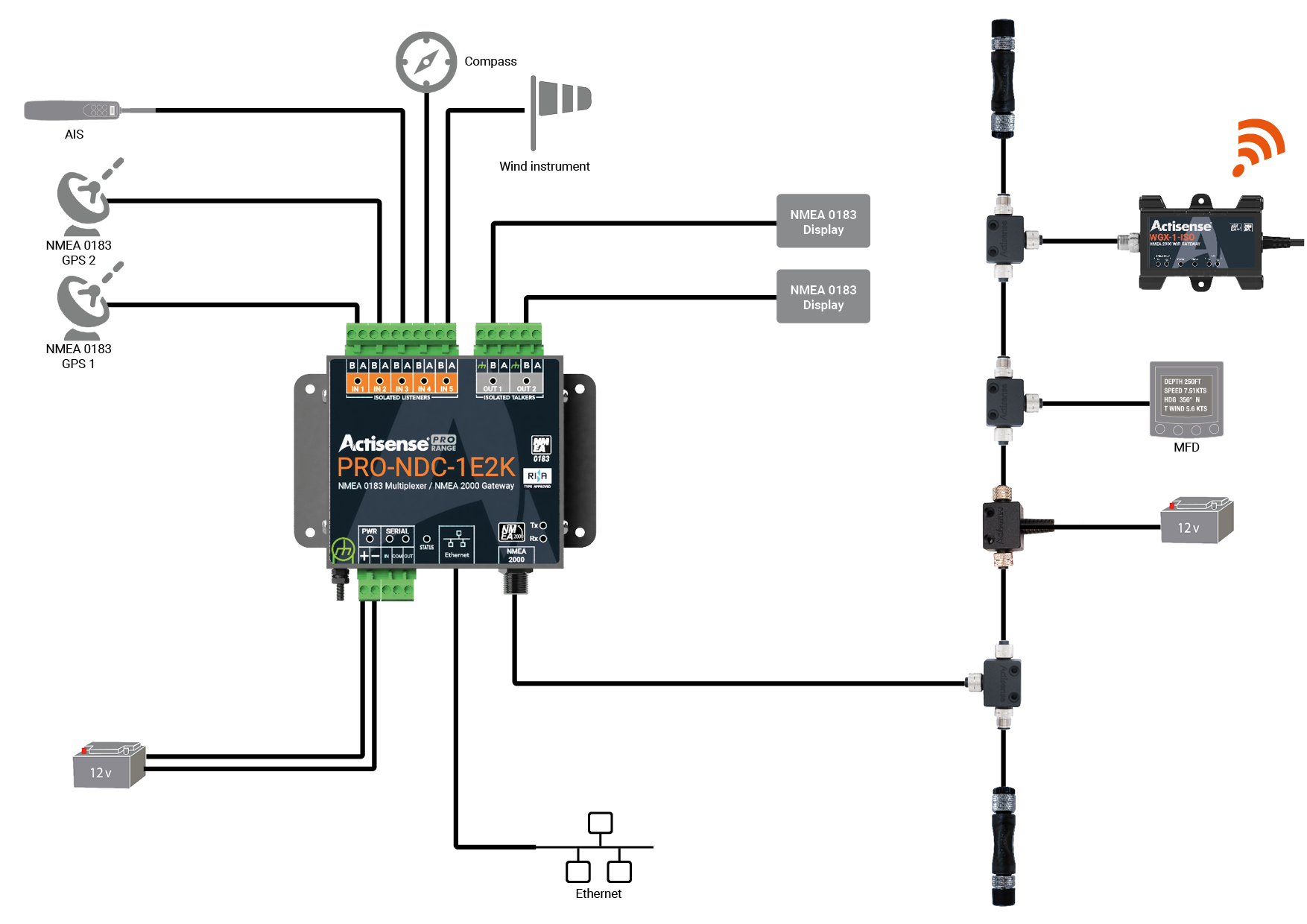
In mixed-manufacturer environments, using an Actisense W2K-2 as a central N2K/Wi-Fi gateway is often more reliable than depending on an MFD to share bus data, as it gives all clients independent access to the N2K bus data, so long as they are connected to the W2K-2. For a wired solution, the PRO-NDC-1E2K is the best choice, as it allows NMEA 0183, NMEA 2000 and Ethernet integration all through one product.
Remote Access
Forwarding NMEA Data to Shore
With a cellular or satellite router aboard, NMEA data can be forwarded to shore systems for fleet tracking or remote diagnostics. The simplest approach is a TCP connection from a shore server to the vessel’s NMEA TCP server, though this requires a static or dynamic DNS address and careful firewall management.
Voyage Data Logging
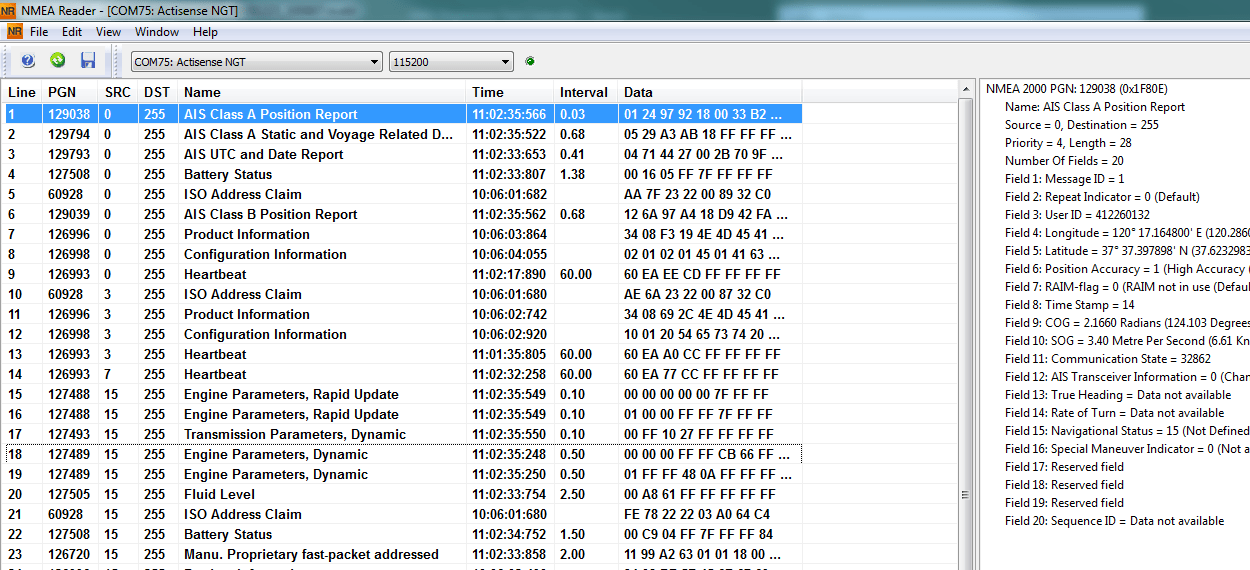
For onboard logging, a navigation PC can write all NMEA sentences to timestamped log files for later replay or analysis. Actisense NMEA Reader includes built-in logging that captures everything received from connected Actisense gateways, making it a practical starting point without additional software.
In summary…
Bridging NMEA 0183 and NMEA 2000 data to a vessel’s Ethernet network is straightforward with the right hardware.
The result is a vessel where instrument data flows freely to chartplotters, navigation software, logging systems, and remote monitoring tools, without the sprawl of point-to-point serial cables that characterises older installations. As marine electronics become increasingly software-driven and network-centric, a well-designed Ethernet instrument backbone is the most practical foundation to build on.
 NMEA 0183 data streaming over Ethernet: Benefits and how it works