


 | Published: April 1, 2026 | Updated: April 2, 2026
Retrofitting NMEA 2000 onto an older boat with existing NMEA 0183 equipment
A practical guide for boat owners looking to upgrade their onboard electronics network without ripping everything out and starting again.
TL;DR
- Boats with older NMEA 0183 electronics don’t need a full rewire to benefit from modern NMEA 2000 networking – the two standards can run side by side using gateway products.
- NMEA 0183 is a one-to-one serial protocol. NMEA 2000 is a multi-device network bus where all devices share a single backbone cable.
- The Actisense NGX-1 acts as a bidirectional converter between the two standards.
- The Actisense PRO-NDC-1E2K combines NMEA 0183 multiplexing, NMEA 2000 conversion, and Ethernet streaming in one device (replacing what previously required multiple separate devices).
- The Actisense W2K-2 adds wireless access to the N2K network, letting tablets and phones running chart apps receive live navigation data without a physical connection.
- The Actisense EMU-1 digitises analogue engine data (oil pressure, temperature, etc.), enabling NMEA 2000 display devices to monitor the connected engine(s) on a vessel, saving the cost and time of replacing an engine.
- A retrofit can be planned methodically and installed without a full rewire, whilst also using Actisense’s free NMEA Reader and Toolkit software to monitor and diagnose the network once installed.
Introduction
If your boat was fitted out more than a decade ago, there’s a reasonable chance its electronics are wired together using NMEA 0183 – the robust serial communications standard that has kept navigation electronics talking to one another since the early 1980s. It works, it’s well understood, and plenty of kit still uses it. But modern chartplotters, multifunction displays (MFDs), autopilots, AIS transponders, and instrument systems utilise NMEA 2000 (N2K), a faster, more capable network standard that allows many devices to share data over a single backbone cable.
The good news is that you don’t have to choose between your existing investment and the benefits of NMEA 2000. With the right gateway products, you can run both standards side by side, translating data seamlessly between them.
This article explains how NMEA 2000 works, how it differs from NMEA 0183, and how to use Actisense products to bring the two worlds together aboard your boat.
Understanding the two standards
NMEA 0183: the veteran
NMEA 0183 is a one-to-one serial protocol. Data is sent as human-readable ASCII sentences – strings of standard sentences beginning with a dollar sign, such as $GPGGA for GPS position or $IIVHW for speed through water. The protocol runs at a modest 4800 baud usually, with AIS operating at a higher 38400 baud.
The limitation is architectural. If you want your GPS to talk to your chartplotter, your autopilot, and your VHF radio simultaneously, you need to wire the GPS output to all three listener inputs, and you still can’t easily get data flowing in both directions on a single pair of wires. Add more devices and the wiring becomes a spaghetti nightmare. Whilst NMEA 0183 does support a single talker multi-listener style setup, it’s a lot of wiring.
NMEA 2000: the modern network
NMEA 2000 is a proper network – a CAN bus (Controller Area Network) running at 250 kbits/second. All devices connect to a single backbone cable via drop cables and T-piece connectors. Every device can both transmit and receive. Data is structured in binary Parameter Group Numbers (PGNs), which are compact, efficient, and standardised. Add a new device anywhere on the backbone, and it immediately becomes part of the network.
The result is a cleaner installation, faster data rates, and genuine multi-master communication. Your autopilot, chartplotter, AIS, wind instruments, depth sounder, and engine monitor all share the same bus, and every device that needs a piece of data can have it.
Why Actisense?

Actisense has been designing and manufacturing NMEA interface products for over 25 years, winning multiple awards across the years. The hardware is trusted by professional installers, superyacht integrators, and racing sailors alike. Crucially for retrofit projects, we have built our product range specifically around the problem of networking and interfacing products. Bridging NMEA 0183 and NMEA 2000 – not as an afterthought, but as a core engineering mission.
Our products are also widely compatible with third-party systems, including Garmin, Raymarine, Furuno, B&G, Simrad, and Navionics, making them genuinely useful across the range of equipment you’re likely to encounter on a real boat install.
Planning your retrofit
Before purchasing any hardware, take stock of what you have and what you want to achieve.
Audit your existing NMEA 0183 devices. List every piece of electronics onboard and note what data each one produces (talker) and what data it consumes (listener). Common sources include GPS receivers, AIS transponders, wind instruments, depth sounders, and speed logs. Common consumers include chartplotters, autopilots, VHF radios with DSC, and radar units.
Identify what you want to add. Are you fitting a new MFD that’s N2K-only? Adding an engine monitoring system? Installing a solid-state compass that outputs N2K data? Knowing your end goal shapes which Actisense products you need.
Decide on your backbone. If you’re installing NMEA 2000 from scratch alongside your existing 0183 network, you’ll need to plan the backbone routing through the boat, typically from the helm station, through the chart table, and out to key sensor locations.
Key Actisense products for the retrofit
-
The NGX-1: the heart of the bridge
The Actisense NGX-1 is the current-generation dual gateway that combines the functionality of the previous NGW-1 and NGT-1 products into a single, cost-effective unit. Depending on how it is configured, it can operate either as a bidirectional NMEA 0183 ↔ NMEA 2000 converter, or as an NMEA 2000 PC interface (though it cannot perform both functions simultaneously). For most retrofit projects centred on 0183-to-N2K conversion, it will be configured in converter mode.
As a converter, the NGX-1 translates NMEA 0183 sentences into NMEA 2000 PGNs and vice versa. A GPS receiver outputting $GPGGA, $GPRMC, and $GPVTG sentences over NMEA 0183 can have its data translated into PGN 129025 (Position Rapid Update), PGN 129026 (COG & SOG Rapid Update), and PGN 127258 (Magnetic Variation) on the N2K backbone, where every N2K device on the bus can consume them. Equally, N2K data from a chartplotter or autopilot can be sent back out as 0183 sentences to legacy equipment.
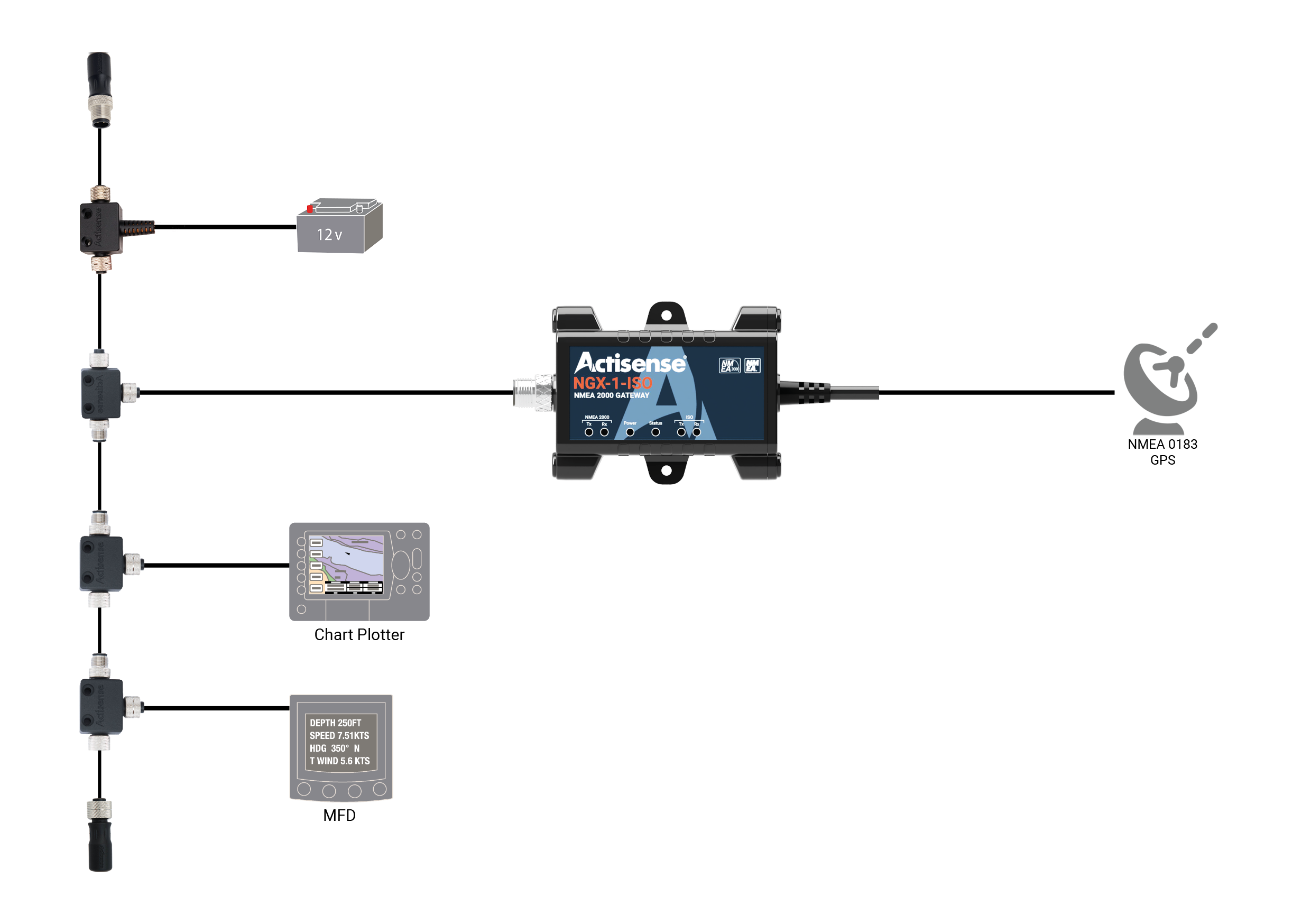
The NGX-1 features the most extensive NMEA 0183/2000 conversion library of any gateway on the market, and is configured via the free Actisense Toolkit software. It is available in two variants: the NGX-1-USB, which connects directly to a PC or laptop via USB for use as a PC gateway; and the NGX-1-ISO, which has an opto-isolated NMEA 0183 input and ISO-Drive output for direct wiring to 0183 instruments or a serial port. Both variants connect to the N2K backbone via a standard Micro T-piece and draw power from the bus.
When configured as a PC interface (transfer mode), the NGX-1 presents the full N2K bus to a connected computer, enabling software such as TimeZero, OpenCPN, or Actisense NMEA Reader to access all network traffic. It also allows configuration of other Actisense products, including the EMU-1, via Actisense Toolkit.
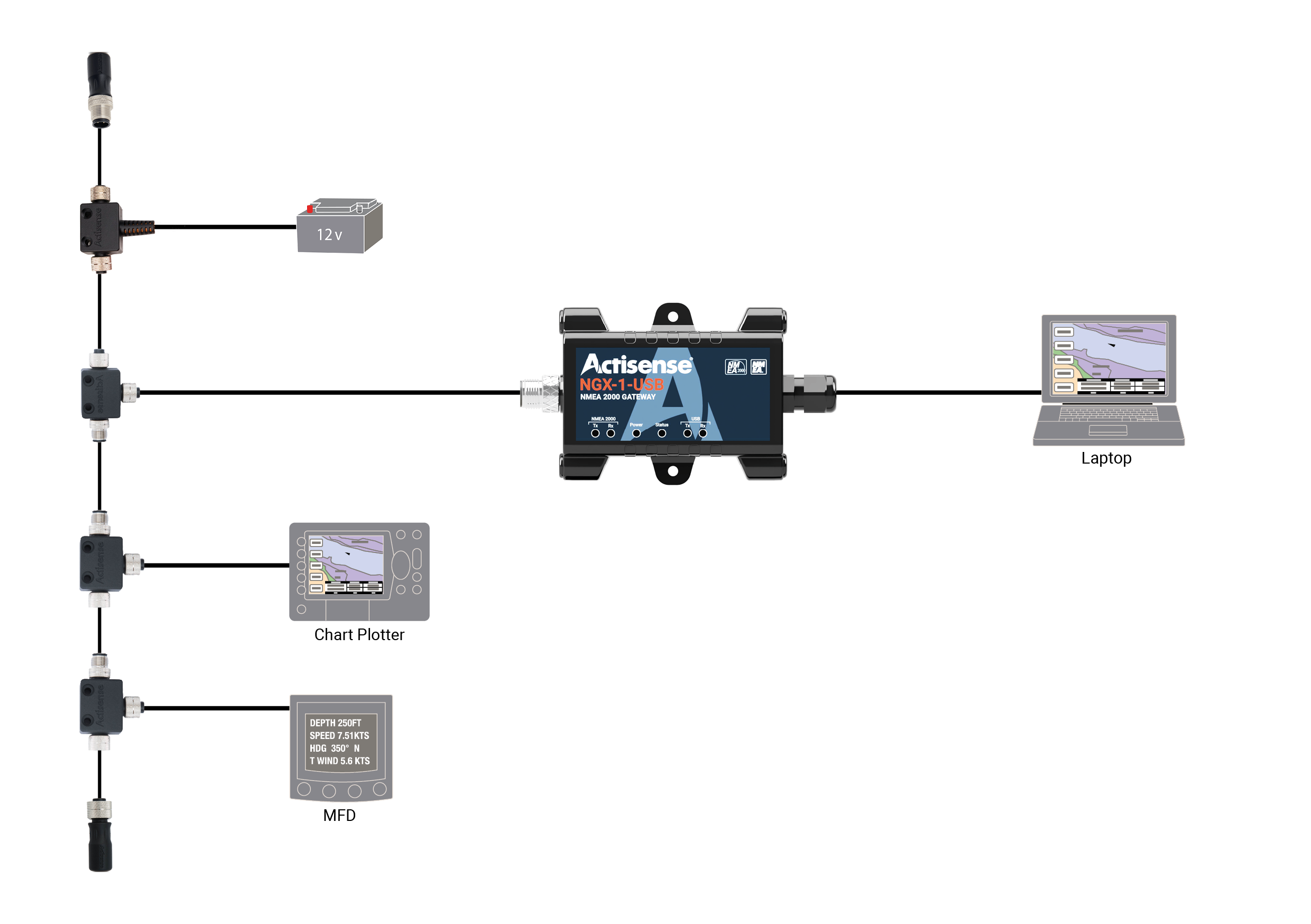
Important note: Because the NGX-1 can only operate in one mode at a time, installations that need both NMEA 0183 conversion and PC access to the N2K bus will require either two NGX-1 units (one in each mode), or a combination of the NGX-1 in PC transfer mode alongside the PRO-NDC-1E2K handling the 0183-to-N2K conversion (see below).
Typical use case: You have an older GPS plotter that outputs NMEA 0183 and a new Raymarine Axiom MFD that speaks NMEA 2000. The NGX-1 (in converter mode) sits between them, feeding GPS position data onto the N2K backbone so the Axiom and any other N2K device can receive it. Alternatively, with a laptop as your chart display, the NGX-1 in PC transfer mode pulls all N2K data (position, speed, depth, wind, AIS ) and presents it to OpenCPN or TimeZero as a single stream.
-
The PRO-NDC-1E2K: the professional all-in-one multiplexer and gateway
The Actisense PRO-NDC-1E2K is a significant step forward from the older NDC-4 and NDC-5 combiners, and for many retrofit installations, it changes the architecture considerably. The PRO-NDC-1E2K integrates NMEA 0183 multiplexing, NMEA 2000 conversion, and Ethernet data streaming into a single RINA type-approved unit, making it the world’s first type-approved multiplexer featuring all three connectivity protocols.
The PRO-NDC-1E2K provides five opto-isolated NMEA 0183 inputs and two ISO-Drive NMEA 0183 outputs (with a serial port adding a sixth input and third output), a direct NMEA 2000 M12 backbone connection, and an Ethernet port. Inputs support baud rate configuration, meaning 4800 and 38400 baud devices can be mixed across the same unit without issue. Advanced sentence-level filtering, data routing, and automatic failover between primary, secondary, and tertiary input sources give the installer precise control over what data flows where.
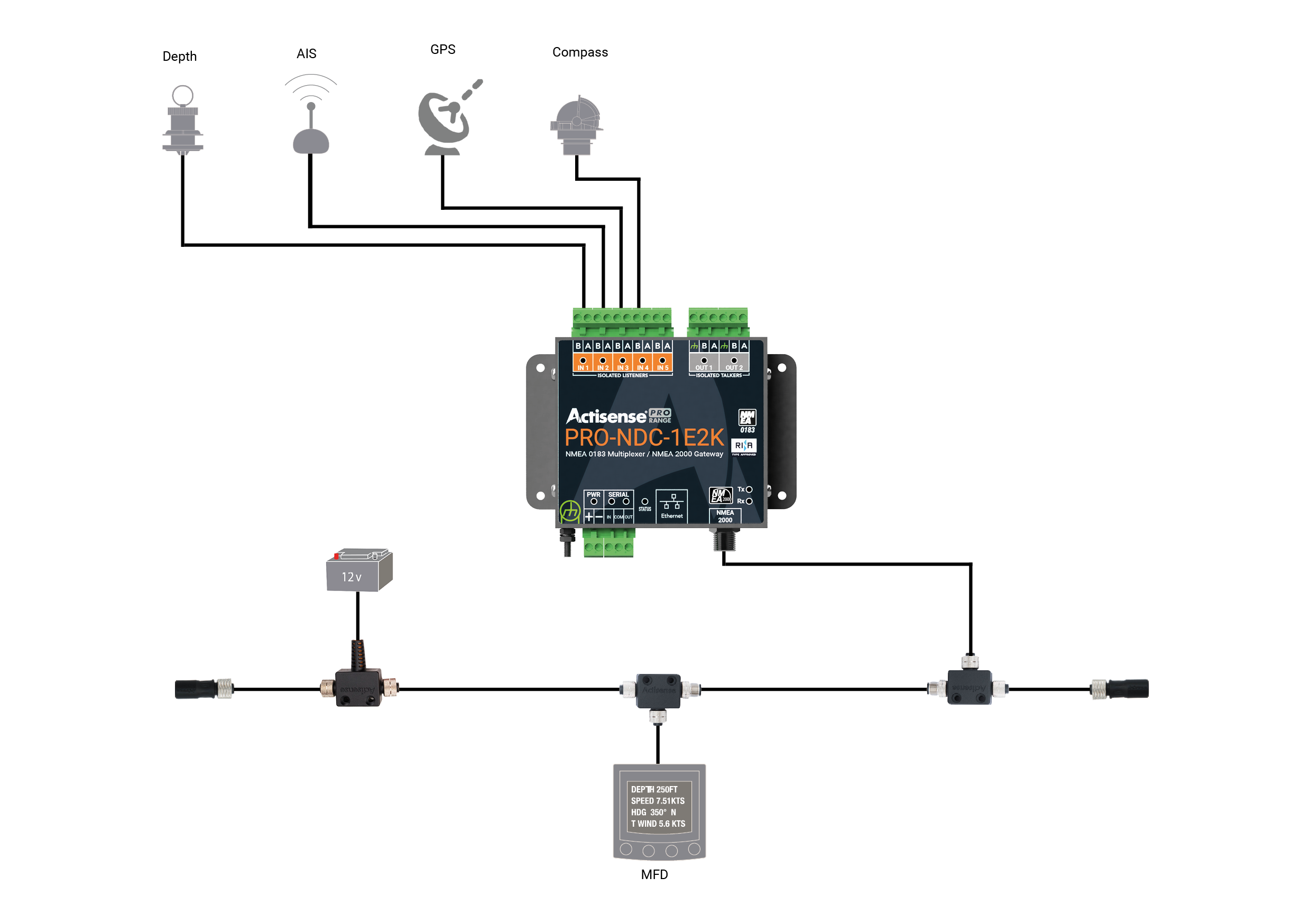
The built-in NMEA 2000 connectivity means that in many retrofit scenarios, the PRO-NDC-1E2K can replace both the old NDC-5 combiner and the NGW-1 gateway in a single box. All combined 0183 data is converted directly to N2K PGNs and placed on the backbone – without needing a separate gateway in the chain.
The Ethernet port enables high-speed bidirectional data streaming in multiple formats (NMEA 0183, RAW, Actisense NGT, and others) to any device on an existing onboard IP network. This completely eliminates serial bandwidth constraints and allows the PRO-NDC-1E2K to share data with chart plotters, MFDs, and software clients across a network switch simultaneously. Configuration is handled entirely through a browser-based web interface, with no need for proprietary software or serial connections; simply connect an Ethernet cable to a laptop or router and navigate to the device’s address.
The PRO-NDC-1E2K is housed in a robust stainless steel enclosure, is panel-mountable, and comes backed by Actisense’s five-year warranty on registered products.
Typical use case: Your boat has a NASA Target wind instrument, a Garmin GPS 152, a standard depth sounder, and a Standard Horizon AIS transponder running at 38400 baud. All four connect to the PRO-NDC-1E2K inputs. The device combines, filters, and converts this data, placing it directly onto the N2K backbone via the M12 connector — and simultaneously streams it over Ethernet to a laptop running OpenCPN. No separate gateway or combiner is needed.
-
The W2K-2: wireless access to your N2K network
The Actisense W2K-2 is the current-generation WiFi gateway that supersedes the W2K-1. It connects to your NMEA 2000 backbone and makes the entire network’s data stream available wirelessly, allowing iPad-based chart apps like Navionics, iNavX, or SEAiq to receive live GPS, AIS, depth, wind, and instrument data without any physical connection.
The W2K-2 supports up to three simultaneous data servers over TCP or UDP, streaming data in selectable formats to suit whichever navigation app or software you’re using. It features built-in NMEA 2000 to NMEA 0183 conversion, meaning legacy apps that only understand 0183 sentences can still receive N2K-sourced data wirelessly. Security has been upgraded to WPA3 (a step ahead of the WPA2 used by many competing wireless gateways) with a unique SSID and password printed on each unit. The W2K-2 operates simultaneously as both an Access Point (creating its own WiFi network) and a Client (joining an existing onboard network), making it flexible for different installation scenarios.
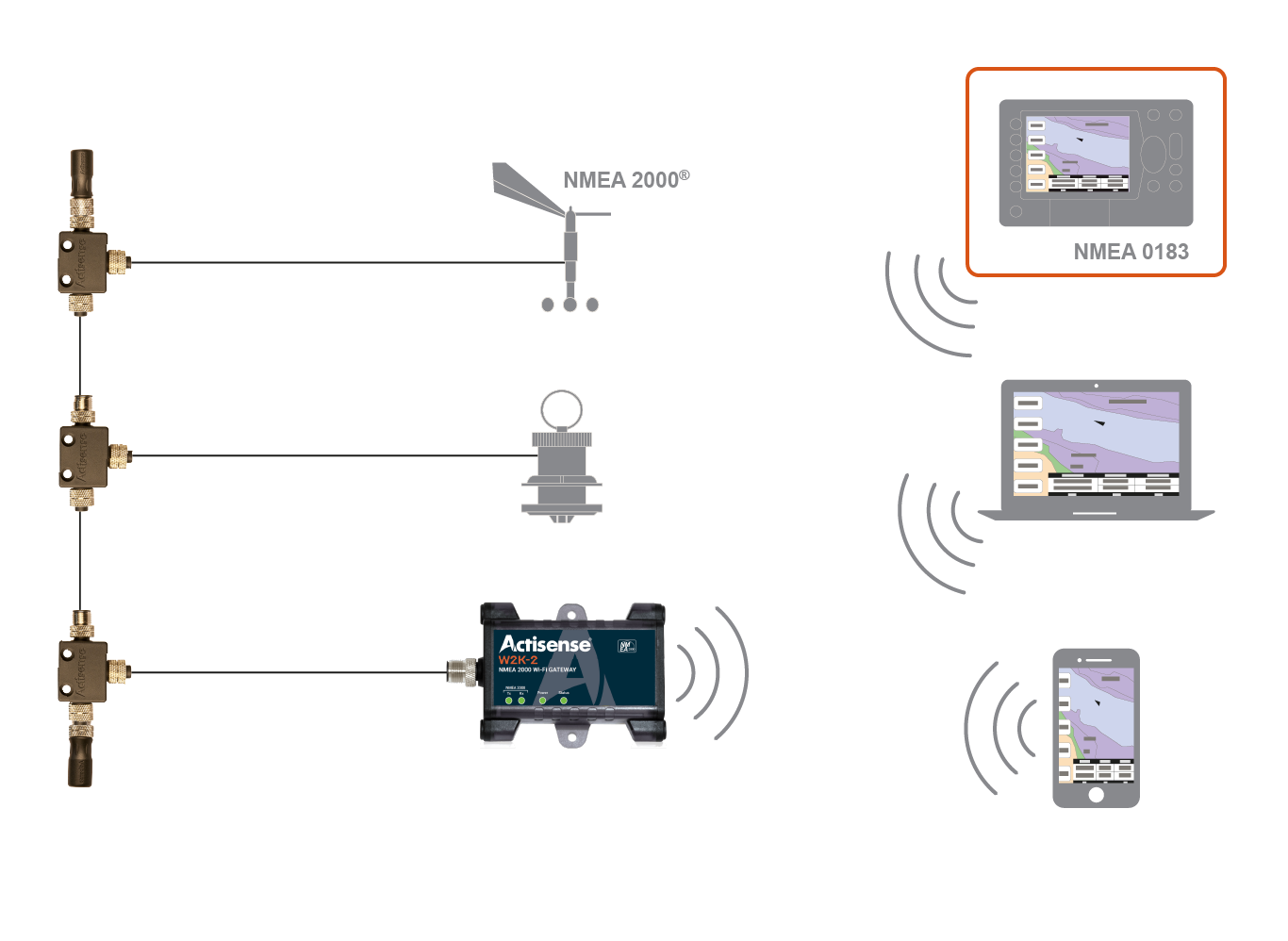
Onboard data logging is supported via a micro SD card slot accepting cards up to 128GB, providing weeks or more of complete N2K bus data recording in EBL (Electronic Binary Log) format, accessible remotely for post-voyage analysis, race data review, or fault diagnosis. The Actisense-i diagnostics tools are included as standard, allowing bus voltage monitoring and device status checking from any connected browser. The unit automatically measures and reports N2K bus voltage, and uses less than 2 LEN from the bus, keeping its power footprint minimal.
For retrofitters, the W2K-2 adds a wireless dimension to the N2K backbone being built, instantly modernising how crew and guests interact with navigation data, without touching the existing hardwired 0183 infrastructure at all.
-
The EMU-1: bringing engine data onto N2K
Many older diesel engines have analogue senders for oil pressure, coolant temperature, and alternator voltage, feeding traditional analogue gauges. The Actisense EMU-1 (Engine Monitoring Unit) connects to these existing senders and outputs the data as NMEA 2000 PGNs (PGN 127488, 127489, 127505, etc.), making engine data available on any N2K MFD or instrument display.
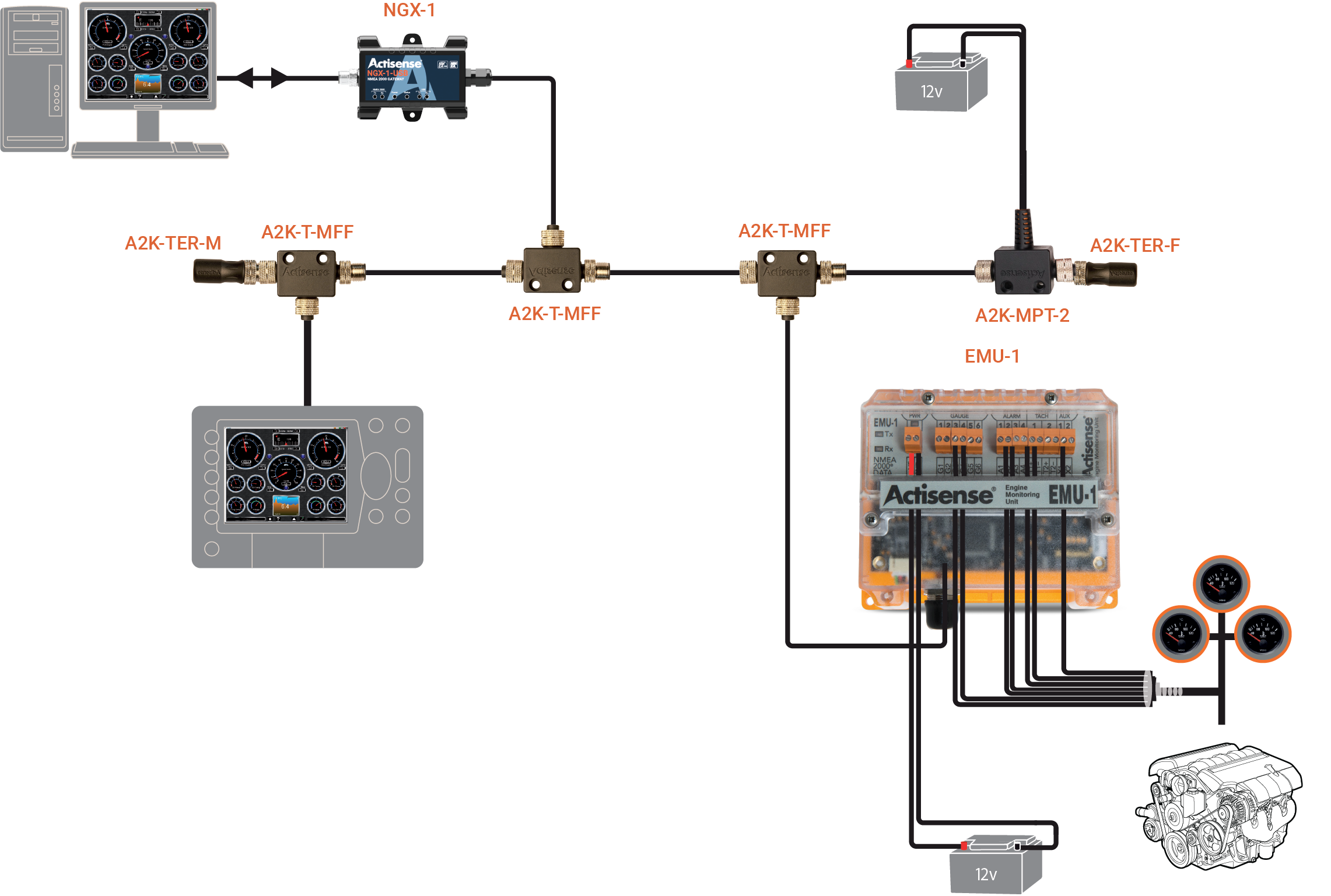
For a retrofitter with a well-established mechanical engine installation, this is transformative: you gain engine monitoring on your new chartplotter or N2K instrument display without replacing the engine, simply by tapping into the existing sender wires.
A typical retrofit wiring scenario
To illustrate how these products work together, consider a typical sailing yacht:
Existing equipment:
- NASA Target wind and depth instruments (NMEA 0183 out, 4,800 baud)
- Garmin GPS 152H chartplotter (NMEA 0183 out, 4,800 baud)
- Standard Horizon AIS/VHF with AIS output (NMEA 0183, 38,400 baud)
New equipment being added:
- Raymarine Axiom 9 MFD (NMEA 2000)
- Garmin GHP 10 autopilot (NMEA 2000)
The Actisense solution:
- Install a NMEA 2000 backbone running from the helm to the chart table, using the Actisense A2K cable range.
- Connect the Axiom 9 and GHP 10 autopilot to the backbone via T-pieces and drop cables.
- Wire the NASA instruments, Garmin GPS, and Standard Horizon AIS output into the PRO-NDC-1E2K inputs.
- Connect the PRO-NDC-1E2K directly to the N2K backbone via the M12 connector. The device handles both the multiplexing and the NMEA 0183-to-N2K conversion internally — no separate gateway required for this data path.
- Add the W2K-2 to the backbone to enable wireless data streaming to iPads and phones running Navionics or other chart apps.
- If PC-based navigation software such as OpenCPN or TimeZero is also needed, add an NGX-1 (in transfer/PC interface mode) to the backbone and connect it to the laptop via USB. Alternatively, use the PRO-NDC-1E2K’s Ethernet output to feed the laptop directly over the onboard network.
The result: the Axiom 9 displays wind, depth, GPS position, and AIS targets sourced from the existing 0183 instruments. The autopilot receives heading, speed, and position data from the backbone. The old GPS chartplotter continues to function independently on its own 0183 output. The Standard Horizon VHF still receives DSC position data from its own internal GPS, unaffected. Crew can access all navigational data wirelessly on tablets via the W2K-2.
Practical installation tips
Power budgeting matters. NMEA 2000 backbones are self-powered via the bus cable, but the power supply must be adequate. Actisense recommends calculating the Load Equivalence Number (LEN) of all devices on the bus and ensuring your power injector or dedicated supply can handle the total draw. Most simple installations are well within limits, but larger systems with many devices warrant checking.
Keep the backbone tidy. The NMEA 2000 standard specifies maximum backbone and drop cable lengths. Keep drop cables (from backbone T-piece to device) under 6 metres wherever possible. Use proper termination resistors (120 ohm) at each end of the backbone. This is non-negotiable for reliable network operation.
Use Actisense’s NMEA Reader and Toolkit software. The free Actisense NMEA Reader utility works with the NGX-1 (in transfer mode) and allows you to monitor all traffic on your N2K backbone in real time, verify that PGNs are being transmitted correctly, and diagnose any translation issues. The Actisense Toolkit application handles full configuration of the NGX-1, EMU-1, and PRO-NDC-1E2K, and can also update device firmware. Both are indispensable commissioning tools.
Actisense has done the hard engineering work of making this hybrid approach practical and robust. For the boat owner, the result is a retrofit that can be planned methodically, installed without a full rewire, and trusted to work reliably at sea, which is, after all, what matters most.
| Product | Function | Key use case |
| NGX-1 | Dual gateway: bidirectional NMEA 0183 ↔ N2K converter, or N2K PC interface (one mode at a time) | Bridge between old and new network; PC/software access to N2K bus |
| PRO-NDC-1E2K | Type-approved NMEA 0183 multiplexer with built-in N2K conversion and Ethernet | Combine multiple 0183 instruments and put data directly onto N2K backbone |
| W2K-2 | NMEA 2000 to WiFi gateway with data logging and WPA3 security | Wireless data to tablets and phones; voyage data recording |
| EMU-1 | Engine monitoring unit | Puts analogue engine data onto N2K |
 Why upgrade your boat’s network from NMEA 0183 to NMEA 2000?